
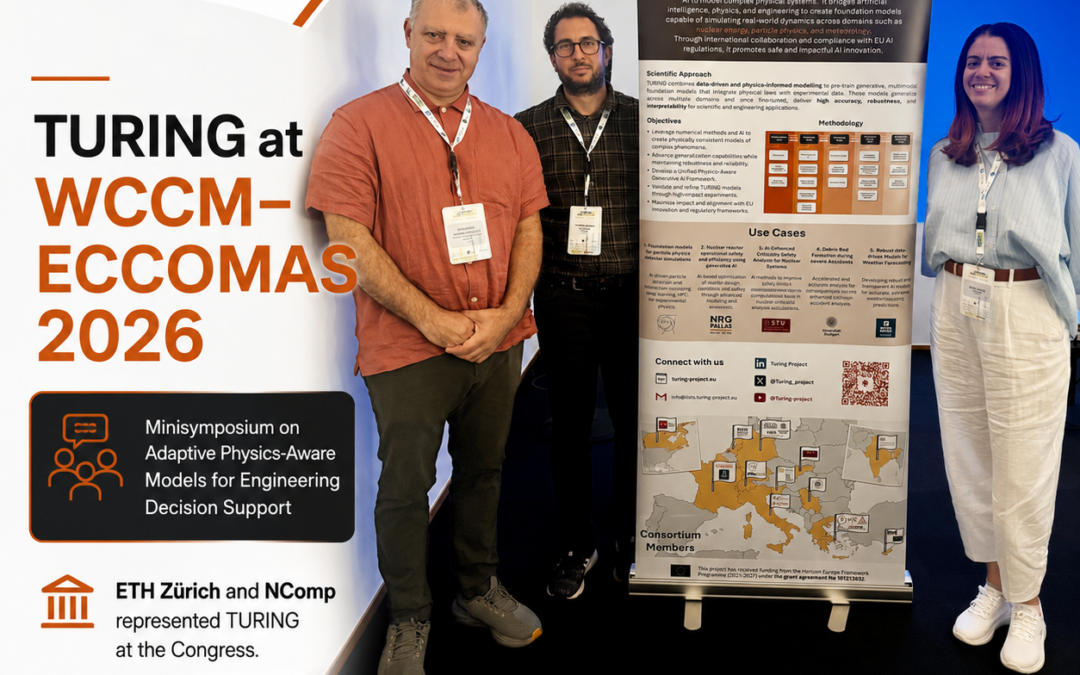
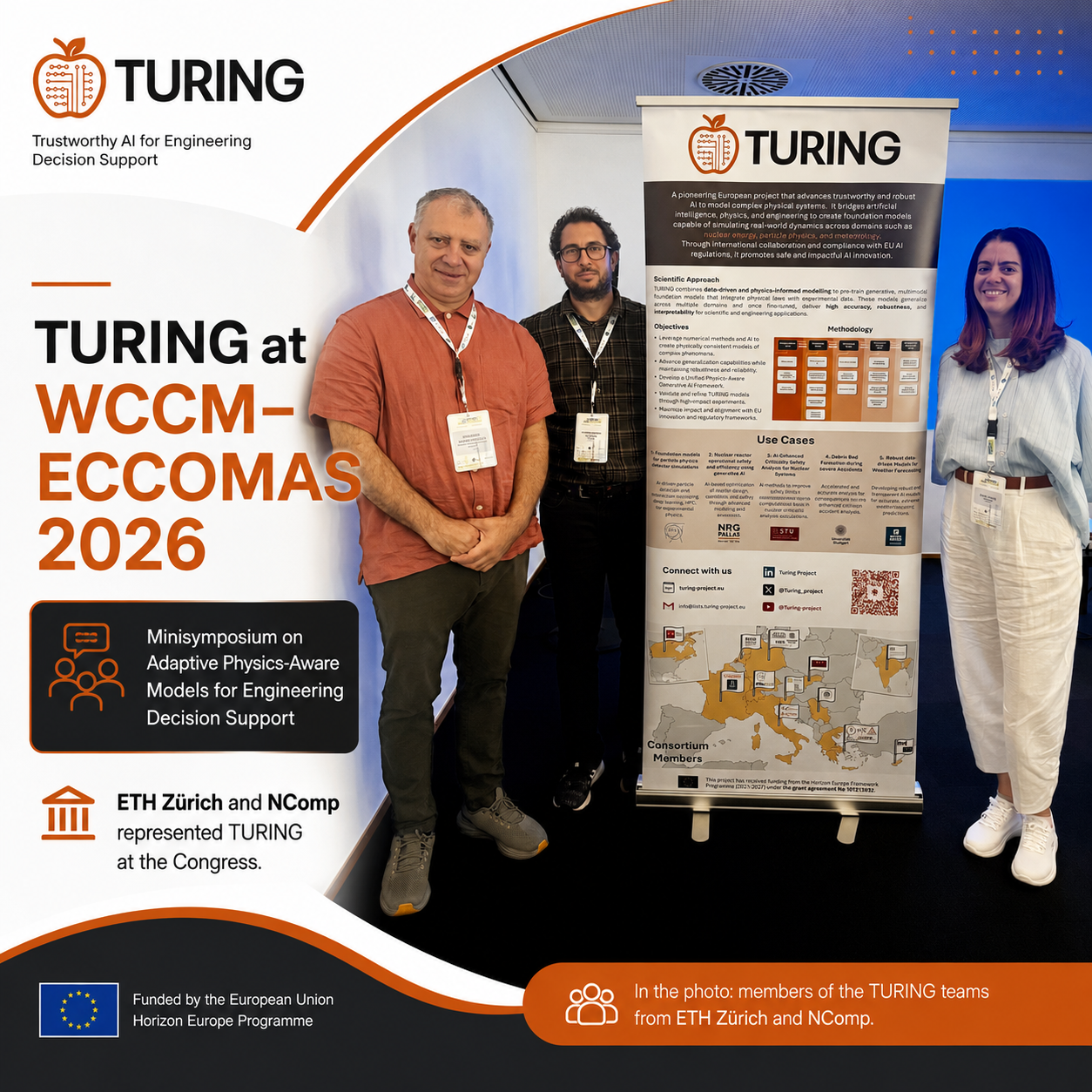
The TURING project participated in WCCM–ECCOMAS 2026, the 17th World Congress on Computational Mechanics and 10th European Congress on Computational Methods in Applied Sciences and Engineering, held from 19 to 24 July 2026 in Munich, Germany.
TURING was represented at the Congress by project teams from ETH Zürich and NComp, contributing to the scientific programme through the organisation of a dedicated minisymposium, session chairing and research presentations.
As part of the Congress programme, the TURING team from ETH Zürich organised the minisymposium “Adaptive Physics-Aware Models for Engineering Decision Support.” The minisymposium was held on Friday, 24 July, at the ICM – International Congress Center Messe München and comprised two consecutive sessions in the Salzburg Room.
Organised by Konstantinos Vlachas, Rui Zhang and Eleni Chatzi from ETH Zürich, the minisymposium addressed an important challenge at the intersection of computational engineering and artificial intelligence: how models can remain reliable when applied beyond the conditions under which they were originally developed.
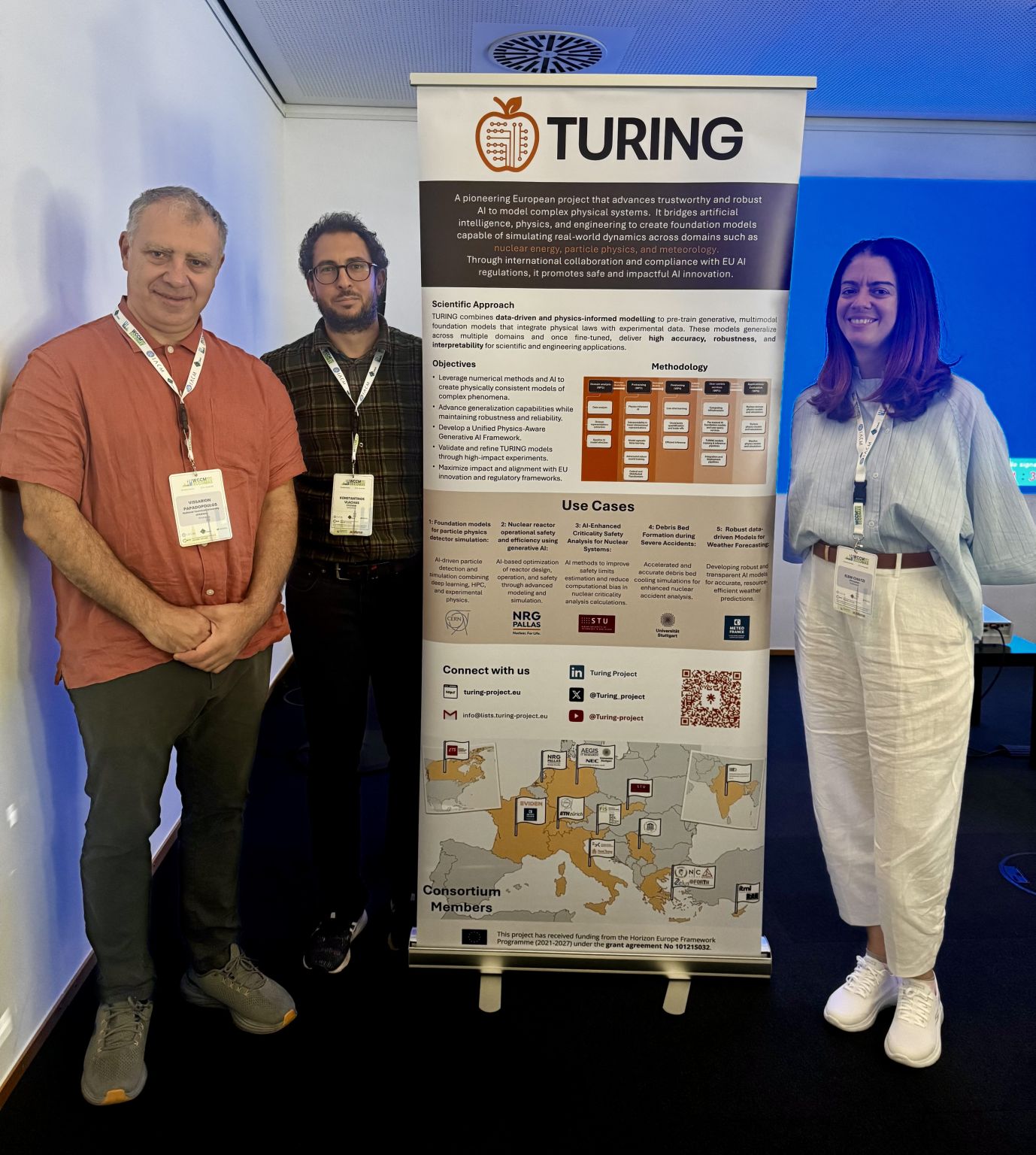
Members of the TURING teams from ETH Zürich and NComp at WCCM–ECCOMAS 2026 in Munich.
This question is closely aligned with TURING’s research on the robustness and reliability of AI-driven models for complex engineering and physical systems. The discussions explored how physics-aware and physics-guided approaches can improve model generalisation, support adaptation to changing operating conditions and contribute to trustworthy engineering decision-making.
The minisymposium attracted 12 accepted submissions, with 10 presentations delivered across the two sessions. The contributions covered topics including physics-guided learning, adaptive modelling, uncertainty-aware methods, structural digital twins, virtual sensing and the use of physics-informed models for real-time engineering decision support.
TURING partner NComp also actively participated in WCCM–ECCOMAS 2026. Vissarion Papadopoulos chaired two sessions on Machine Learning-Enhanced Solvers for Partial Differential Equations in Computational Science and presented the work “Stochastic Manifold-Aware Neural Preconditioning for Parametric Elliptic PDEs.”
The participation of both ETH Zürich and NComp strengthened TURING’s presence at the Congress and created valuable opportunities to exchange knowledge with the international computational mechanics community. It also supported dialogue between physics-based modelling, machine learning and engineering decision support—areas directly connected to the project’s scientific objectives.
We warmly thank all organisers, speakers and participants for their valuable contributions and the stimulating discussions.